|
 The
tree
The
treeDuring the time of the dinosaurs seed plants (spermatophytes) were well developed and were the most dominant vegetation on earth, especially the lush seed ferns, conifers and palmlike cycads. These primitive seed plants are called gymnosperms (meaning "naked seeds") because their seeds are not enclosed in a ripened fruit but are protected by cones or by a fleshy seed coat.
| Most gymnosperms
(and flowering plants) have both sexes on the same plant, but the Ginkgo
is a dioecious gymnosperm, male and female are separate trees, its seeds
have a fleshy outer layer.
The Ginkgo and the cycads are the only living seed-producing plants that have motile or free swimming sperm (more info here). In earlier classification systems
the Ginkgo tree was placed in the class Coniferopsida, because it is thought
to be more related to conifers than to any other gymnosperm, but the two
groups appear to have evolved independently.
Green algae (Coccomyxa) live
in symbiosis with Ginkgo tissues, recent research has shown. So far this
association is not known on any other tree and only occurs in the
animal kingdom.
|
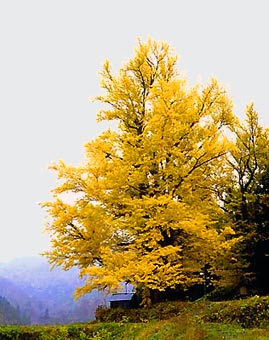
old Ginkgo in Japan photo Hiroshi Takahashi
|
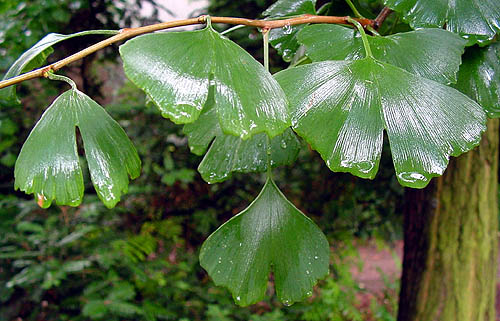 |
You can distuinguish a Ginkgo from other gymnosperms by its fan shaped and bilobed leaves. All Ginkgo trees have a relatively primitive vascular system. The veins continuously divide into two's. This vein pattern (dichotomous venation) is unique to the Ginkgo. |
Because of its unique position
botanists found it difficult to classify the Ginkgo. Therefore the Ginkgo
has been placed in a separate group in recent years, the division (phylum)
Ginkgophyta.
This division consists of the
single order Ginkgoales (Engler
1898), a single family
Ginkgoaceae (Engler 1897),
a single extant genus Ginkgo.
Click
here for the classification scheme 
There are two extinct genera:
Ginkgoites and Baiera (known from fossilized leaves).
The only living representative
of the order Ginkgoales is the Ginkgo biloba.

| The Ginkgo has long
and short
branches
growing
at nearly right angles. A short branch may become a long branch and the
tip of a long branch may change into a short branch. That's why older trees
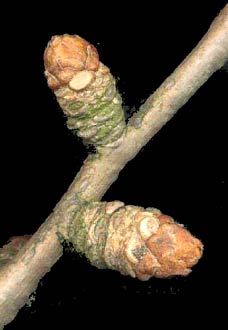
may have a more irregular form. The buds are mounded with distinct form
and leaf scars. The leaves grow alternate on the long branches during spring.
On the ends of short, lateral shoots they grow very slowly in clusters
and produce a long shoot with scattered leaves after a number of years.
The short shoots also produce the seeds and pollen. The stems are tan,
light brown or gray, relatively smooth and are somewhat reflective in the
winter sun. Some trees tend to have branches crossing the trunk.
The girth of the trunk of the older trees may become large because of secondary growth. The tree usually loses its central leader and gives rise to several vertical trunks ("basal chichi") that keep reaching great heights. These socalled lignotubers can also be observed on the Sumter plantation (see Usage-page) where the trees are regularly cut down to groundlevel and produce lignotubers that give new shoots and roots.
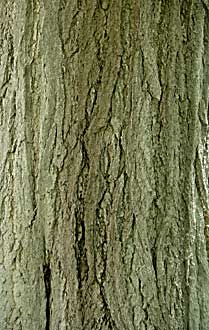
buds and bark |
Video I made of an old Ginkgo tree at Maldegem (Belgium), c. 1840, female, with chichi
Inside the trunk the wood is yellow. The bark is light brown to brownish-gray; more brown, deeply furrowed and ridged on older trees and has a corky texture. |
|
Video
|
Video
|
 |
 |
 |
|
 |

click picture for enlargement and more photos of the wood |
As said before although the Ginkgo is more like a conifer than a deciduous broadleaf tree it is neither, it has a unique position. This also becomes clear when looking at the microscopic structure of the wood. It lacks vessels in the xylem but has slightly rounded tracheids giving rise to intercellular spaces (conifers have regularly close-fitting rectangular tracheids). It has beautiful crystals (called druses) consisting of calcium oxalate. |
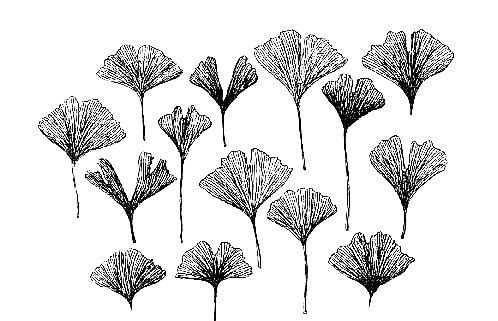
| The leaves are an easy recognizable feature of the deciduous Ginkgo biloba. They are 5- 8 cm wide and are sometimes twice as broad although they vary in size and shape. The leathery leaves have a wax layer on both sides and are slightly thicker than other Northern tree leaves. They consist of a leaf stalk and a fan-shaped dichotomously veined blade: two parallel veins enter each blade from the point of attachment of the long leafstalk and divide repeatedly into two's (picture click here) , are not often cross-connected (seldom fuse). The veins are slightly raised giving a ribbed appearance. The pores are recessed and limited thereby reducing waterloss from evaporation. The form is bilobed, it has no midrib and is fan-shaped. The leafstalk is also about 8 cm (3 inches) long causing the foliage to flutter in the slightest breeze. |
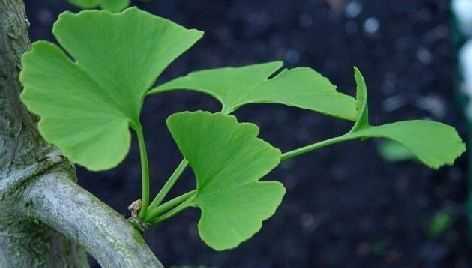
HD VIDEO - GINKGO LEAVES : |
The leaf resembles
the leafshape of a Maidenhair fern (Adiantum), hence the plant's nickname,
the Maidenhair tree.
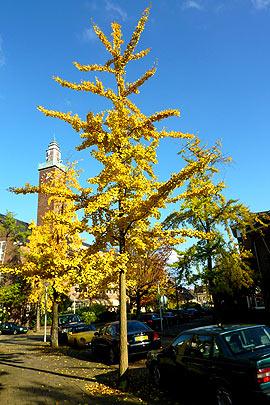
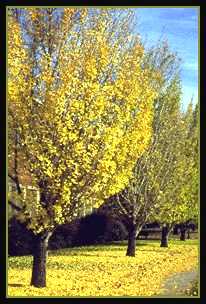
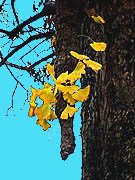
A deep vertical slit in the top center divides the leaf into two lobes mostly on the upper part of long branches. The leaf can also have more than two lobes, esp. on the lower part of the tree. There is great variation in the degree of lobing on the same tree and this also seems to vary from tree to tree. The colour is gray-green to yellow- to darkgreen in summer, turning in yellow and in good years a beautiful golden yellow colour in fall. Certain selected cultivars yearly have this golden yellow colour in fall. |
The
leaves remain on the tree until late in the season and then can all fall
rapidly in a single or a few days and even in 1 or 2 hours!
To
watch many unique videos of the Ginkgo "raining" leaves in fall click
here. |
|
HD-Video: Ginkgo in fall in Amsterdam. |
Slideshow: Ginkgo in fall impressions. |
 |
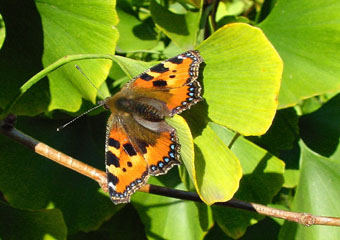
The form of a butterfly resembles
a Ginkgo leaf.
 Drawings:
|

The extract of the dried leaves is popular for their use as a diet supplement and/or herbal medicine (prescribed in Europe) for the brain, legs, eyes, heart and ears. Scientific studies show that good extracts may improve bloodcirculation and memory, prevent bloodclotting, damage by free radicals and give an improved sense of well-being and can be used for many other disorders. The leaves are also used as tea for a variety of ailments.
The fungus Bartheletia paradoxa is a living fossil like Ginkgo biloba and grows on fallen Ginkgo leaves (it is not present on leaves on the tree), it does not grow on other plant species.
Read more about this on my Usage-page.
Climate zones 3 to 9 (-30/40 to +20/40 C). So from Iceland to Australia, read my Where-page.
Nearly every arboretum or botanical garden will contain specimens. The supreme specimens are to be found on temple grounds in China, Korea and Japan. In China they also grow in forests and valleys on acidic, well-drained sandy loam (pH 5-5.5) and they are cultivated below 2,000 m (see Where-page).
Ginkgo has survived in some areas
of China where the impact of glaciation was minimal. Populations of Ginkgo
biloba are found across the country, but are generally associated with
human activities.
Questions about the extent of
Ginkgo biloba’s native range in China have been the subject of debate among
botanists for well over a hundred years.
DNA analyses (Zhao
et al., 2019) have demonstrated that Ginkgo populations occur in refugia
in southwestern, eastern and south China.
More info on my History-page.
For places where the Ginkgo has a special growing spot see the page Where on my homepage.
The Ginkgo can have a long life
span, in China the oldest Ginkgo is about 3,500 years old. Research
(article by Li Wang et al., PNAS 2020, lit.page)
shows that the Ginkgo tree is almost immortal, genes in the cambium contain
no program for senescence (ageing) or death. The vascular cambium in Ginkgo
biloba can retain the capacity for continuous growth for over 1,000 years
or even millennia. Old trees bear just as many viable seeds, pollen and
leaves as young ones. The immune system in these trees, even though
they are 1,000 years old, looks like that of a 20-year-old.
Its longevity is due to disease
resistance associated genes that produce protective chemicals to fight
off stresses caused by diseases or other environmental stressors. These
include anti-oxidants, plant hormones and antimicrobials, among which flavonoids.
However it is possible that
if the division rate of cambial cells continues to decline after thousands
of years, tree growth could slow, and the tree might eventually die of
old age.
Most trees however are unlikely
to die from old age, most die from external factors.
The majority of ginkgos live as a hardy ornamental tree and, being nearly cosmopolitan, specimens are planted around the globe in almost any temperate and subtropical areas. In the USA only 0.2-2% of the total number of roadside trees is a Ginkgo, in Europe this is even less (1992). The tree is farmed extensively (esp. for its medicinal use as a herb) in Europe, Japan, Korea and the USA.
In China Ginkgo trees of more
than 100 years old are listed as second class protected plants of the state.
Roads and buildings should give way in order to protect
them well.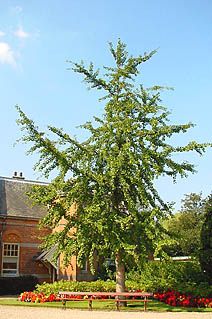
Some people think there's a good
opportunity to plant a Ginkgo tree on special occasions like the death
of a beloved one, the birth of a child, an anniversary, moving house etc.
 |
|
|
Planting:
It
prefers full sun to partial sun and moist,
deep, well-drained soils
(preferably sandy
loam), but is very adaptable, so it also grows in poor soils, compacted
soils, various soil pHs, heat, drought, salt spray in winter and air pollution.
Fertilize
1-2 times a year. Don't mulch with shredded bark round the trunk, keep
it airy. It roots deeply (photos of root system).
The roots of most Ginkgos are infected by vesicular-arbuscular mycorrhizae
(VAM) that play an important role in the uptake of the element phosphorus.
| The Ginkgo tree
is particularly resistant to insect pests and to fungal, viral and bacterial
diseases as well as to ozone and sulfer dioxide pollution, fire and even
radioactive radiation (atom bomb WWII). Therefore it is used as a street
tree, esp. in cities, it never needs spraying.
It can tolerate snow-and icestorms. Research showes that the Ginkgo has no trouble adapting to greenhouse-effect conditions (elevated CO2). It is also planted as a park and landscape tree and in gardens. It is also grown for its shade (little shade when it's young). It is particularly easy to establish in the garden. It initially grows somewhat slowly: it takes 10 to 12 years to become 6 metres (20 feet) tall and it takes about 20 years before it has a rounded shape. It can be trained as an espalier (photos), hedge or climber. |
. Playlist videos of the Ginkgo as a street tree. |
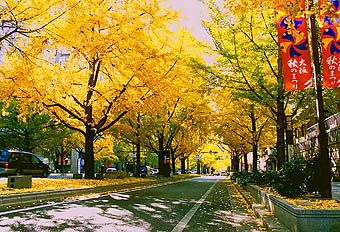
Midousuji Boulevard, Osaka, Japan 900 Ginkgo trees of 1937 in a row of 4.5 km Photo © Sando Tomoki |
Plant in spring
or fall. Young trees tend to grow crooked
and should at first be staked. Give plenty of water (more during dry/hot
periods) until they are about 6 metres (20 feet).
It is slow to recover from transplanting. In favourable conditions the
Ginkgo grows from about late May to the end of August over 30 cm per year
for the first 30 years of its life. In some years it doesn't grow at all,
in others 1 metre of growth can occur, independent of watering or nutrients.
The tree needs no pruning.
|
| Gender:
the tree is dioecious, male and female trees are separate. The sex
chromosomes (XX females and XY males, just like humans) are difficult
to distinguish, so the tree's gender is not easily classified.
The pollen and ovules grow on the short spurts, very seldom on the leaves (Ohatsuki). Occasionally both genders are found on the same tree. After a hot summer or grown in
a warm sunny position the tree produces them more reliably.
|
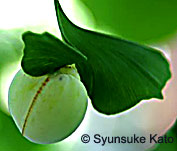
Ohatsuki ovule. More photos of old tree in Japan and ohatsuki leaves. 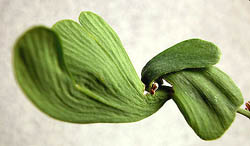
Ohatsuki pollen remain small photo ©
Hiroshi Takahashi
|
They look like cherries. It takes about 20-35 years before they appear for the first time in spring. Catkin-like pollen cones (microsporangia) containing the sperms on the male tree also grow on short shoots in spring (also after about 20-35 years) and the pollination usually takes place via the wind. The female tree can carry seeds without pollination (sterile). Variations in the cycle of pollination, fertilization and seed abscission in Ginkgo are mainly due to the latitude and the local climate of the region in which the tree is growing.
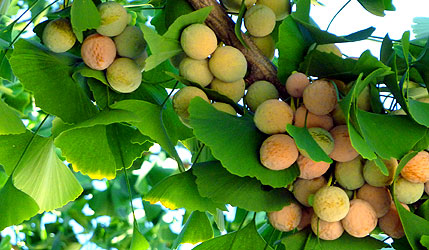
| When the ovules are fertilized they develop into yellowish, plumlike seeds about 2,5 cm (1 inch) long, consisting of a large "nut" (the size of an almond) with a fleshy outer layer. The actual fertilization of the seed by free swimming sperm occurs mostly on the tree (read more here). |
 |
The propagation can also be done by cuttings (the best way to ensure the gender) or by grafting a female branch onto a male plant or visa versa.
Read further about this on my Propagation-page.
The fresh nutritious seeds (also canned with fleshy outer coat removed) are sold in markets esp. in the Orient.
The "nut" has for long been used in Chinese medicine for asthma, coughs with thick phlegm, bronchitis, digestive aid and urinary incontinence etc.
Read further about this on my
Usage-page.
Bonsai
I made a special page about the Ginkgo as a bonsai
tree.
Click here to go there.
HD-video: one of
the oldest Ginkgo trees outside Asia
Geetbets, Belgium,
c. 1750
|
|
|
|
|
|
|
follow me on Twitter |
Many garden centers sell the
Ginkgo biloba. Special cultivars are for sale at nurseries.
The Ginkgo can often be found
in the conifer catalogue (check out my Links-page and/or try search engines).
Male trees are often propagated from cuttings. Always buy from a
reputable firm. Of course I would very much like to have male and female
trees in my own garden, but I only have space for one big tree....
If you have a suitable spot
then please plant a female tree or grow Ginkgos from seed (can become
male or female tree), because they are so rare and when only male Ginkgos
are planted it cannot survive without human intervention.
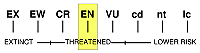
The
Ginkgo is listed in the
IUCN
Red List of Endangered Plants.
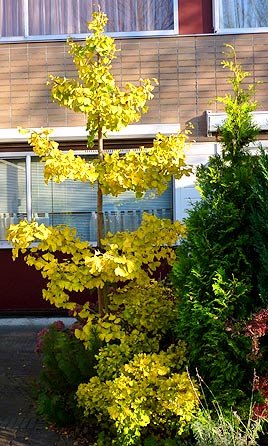
The Ginkgo tree can grow large, therefore it is not the tree for every backyard. Selections are made to make it suitable for places with less space and also to meet with desired shapes etc. Upright, dwarf, narrow and conical, pendulous and variegated cultivars exist, search for them on the internet, ask for them at garden centers and nurseries. Cultivars are mentioned below (but there are many more!).
Ginkgo biloba:
'Anny's Dwarf': compact dwarf form, male, up to 2,5 m
'Autumn Gold':
better fall colour and/or modified broad spreading growth habit, erect
compact oval form, male.
'Barabits Nana/Dwarf':
small bushy form, up to 2 metres.
'Beijing Gold':
shrub form, 4 m, yellow leaves also in spring and summer ( in summer somewhat
striped)
'Bergen op Zoom': small straight up to 4 metres.
'Californian Sunset': mostly yellow at first, becoming striped yellow
'Chase Manhattan':
small, tiny darkgreen leaves, compact, ideal for bonsai and rockgarden,
c. 1.5 m
'Chichi (Icho)':
smaller leaves and a textured trunk, bark has breast-shaped protuberances
'Chris's Dwarf' (or 'Munchkin'?): see 'Munchkin'
'Chotek': weeping form of 'Witches Broom'; cultivar from Czech Republic; found by Mr Horak, Bystrice pod Hostinemin. Named to tribute the house of Choteks, the family of archbishop F. M. Chotek.
'Compacta': semi-dwarf
'Doctor Causton': male and female cultivar
'Eastern Star': female, bears abundant crops of large nuts.
'Elmwood': vertical
columnar form
'Epiphylla': female. Max. 4 m h., more wide. Seeds form on rather young plant.
'Elsie': upright growing, female.
'Fairmount':
slender form, big leaves, dense pyramidal crown, male, 15 m.
'Fastigiata':
architectural vertical accent, nearly columnar form, slightly wider at
the base, big leaves, male (also available as female).
'Geisha': female, long pendulous branches and dark green foliage which turns lemon-yellow in fall, heavy crops of large nuts.
'Globosa':
Graft on stock, bulb-shaped, compact
'Globus': Bullet-form, big leaves.
'Golden globe':
Full head and spectacular yellow fall color. Trees are unusually densely
branched for Ginkgos. Young trees have full crowns that mature in a broad,
rounded head. Male. (from a seedling of Cleveland Tree Co. )
'Gresham':
Wide spreading horizontal branch habit. (from Gresham High School Ginkgos
at Gresham, Oregon)
'Hayanari': female.
'Heksenbezem Leiden' (Witches
broom): quite compact, rounded, dwarf form,
branching closely grouped,
up to 3 metres.
| 'Horizontalis':
tall and wide form, many side-branches.
Wide crown.
'Jade Butterfly':
dense darkgreen foliage clumps, shrubby outline, vase shaped, semi dwarf,
about 3 m. 'King of Dongting': slow growing, very big leaves. 'Laciniata':
large deeply divided leaves 'Lakeview': compact,
conical to broadly pyramidal, male. 'Liberty Splendor': broad pyramidal form with strong trunk, female. 'Long March': Upright growing, female is cultivated for heavy crops of tasty nuts. 'Magyar': uniform symmetrical branching, upright narrow pyramid form, up to 19 metres, male. 'Mariken':
more compact than 'W.B.', tall about 3 ft, w.6-10 ft, branches more or
less pendulous, graft on about 5 ft stock (P. Vergeldt; from a tree in
Nijmegen). 'Mayfield': Narrower form
than Fastigiata, tight upright, short branches, 9-12 m. 'Menhir': slender, upright columnar, straight (Van Vliet) 'Munchkin' (or 'Chris's Dwarf'
?): Upright habit and numerous slender branches, it has a
tendency to be more regular in shape.
'Ohasuki': up to 4 metres, halfround big leaves, female. 'Pendula':
branches more or less pendulous ("weeping"), slow growing, decorative. 'Prague or Pragense': low spreading and parasol-shaped. 'Princeton Sentry':
well known cultivar, slow growing, big decorative leaves, upright conical
form gives very formal focal point, male, 30 m.
'Rainbow': striped with green/yellow leaves, about 3 m. Improved 'Variegata'. Remove green leaved branch immediately. 'Salem Lady': female from Oregon. 'Santa Cruz': female, low, spreading, umbrella-shaped. 'Saratoga':
dense branches, small yellow-green leaves, slow growth, rounded outline,
male, 10 m. 'Shangri-La': fast growing with compact pyramidal form, 14 metres, grows somewhat faster, male. 'Spring Grove': dwarf, very small and compact, about 3 m. 'Tit': = Chichi (Icho). 'Tremonia':
small, pyramidal form, very big leaves, female, 10 m. 'Troll':
compact 'W.B.', leaves vary from normal to rounded (Johann Wieting;
from a tree in Krefeld, Germany. 'Tubifolia':
slender leaves form sort of tub shape, slow growing, decorative, small
tree, fairly compact branching, about 3 m. 'Umbrella':
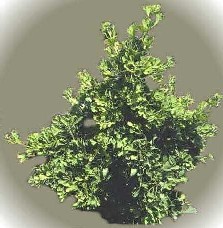
compact, densely branched, different leaf-forms and sizes. 'Variegata': 'Windover': broad oval outline, shade tree, 17 m. 'W.B.' ('Witches Broom'):
dwarf form, compact, rounded, lightgreen leaf, closely grouped branches,
|
|


|
Loading...
|
© Cor Kwant 
Copyright information.


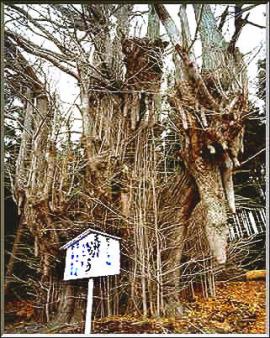
 The
chichi (Chinese: zhong ru) seem to be connected to traumatic events, environmental
stress and individual properties of a tree. It is seen with old, but also
with younger trees. It is thought the chichi, its resistance against diseases,
its adaptability and individual properties of the tree etc. contribute
to the long history of the survival of the Ginkgo.
The
chichi (Chinese: zhong ru) seem to be connected to traumatic events, environmental
stress and individual properties of a tree. It is seen with old, but also
with younger trees. It is thought the chichi, its resistance against diseases,
its adaptability and individual properties of the tree etc. contribute
to the long history of the survival of the Ginkgo.
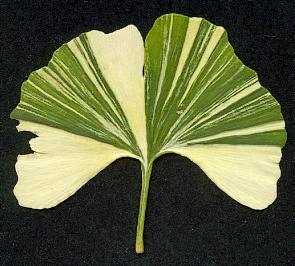 shrub
form with variegated foliage, some leaves 'halved' green and gold,
others striped and others half gold/half striped, up to 3 metres, female.
shrub
form with variegated foliage, some leaves 'halved' green and gold,
others striped and others half gold/half striped, up to 3 metres, female.