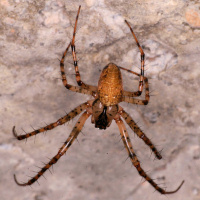
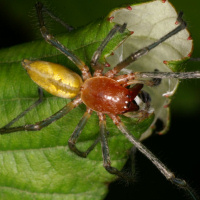
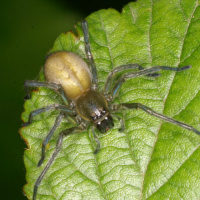
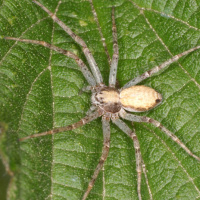
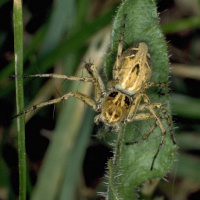
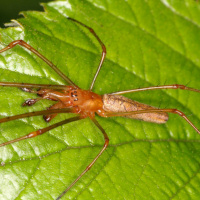
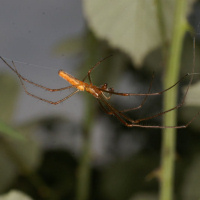
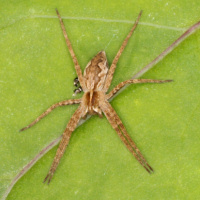
Spiders of North-West Europe

Nederlandse versie
This European spider site contains more than 1300 pictures of over 260 spiders commonly found in NW-Europe, especially in the area between the Netherlands, Germany and the south of France.
There is a thumbnail page and a Spider location chart for a quick overview of all the spiders posted on these pages.
Of all photographed spiders, there is a short description about their habitat, size and other interesting facts.
Here is an Overview of spider know how. Apart from the European spiders I have also posted more than 700 pictures of Australian spiders.

Over eighty pages keep +500,000 visitors busy every year. Most pages are translated in Dutch and some in Esperanto.

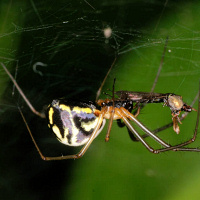
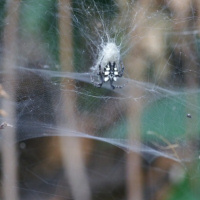
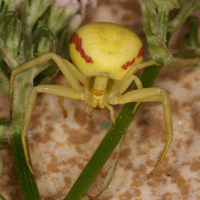
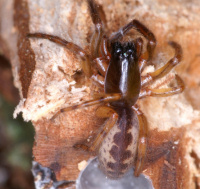
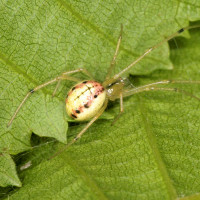
Many people think spiders are dangerous creatures that should be wiped away with a cloth, sucked up in the vacuum cleaner or smashed with a newspaper. That is not wise because spiders play a very important role in our Eco-system. They catch many annoying and harmful insects and are therefore very useful creatures. As you will see on these pages, many of the spiders are beautifully colored, and therefore very pleasant and wonderful to look at. Since most spiders are very small, you need a magnifying glass or a camera to study them or to reveal their beauty.

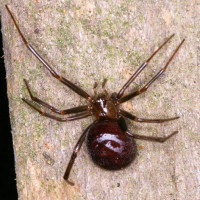
I receive many questions about poisonous/venomous spiders. Most spiders use venom to kill their prey. Spider venom is almost always harmless to humans. However, there are a few exceptions. In Europe there is one spider, called "Black widow", whose effects of the bite may hurt. The stories about her deadly venom are exaggerated. She lives in the southern parts of Europe.
Recent, controlled, studies show that the necrotic or neurotoxic effects of spider bites are often mild and of no medical importance. Severe necroses is never caused by a spider bite.
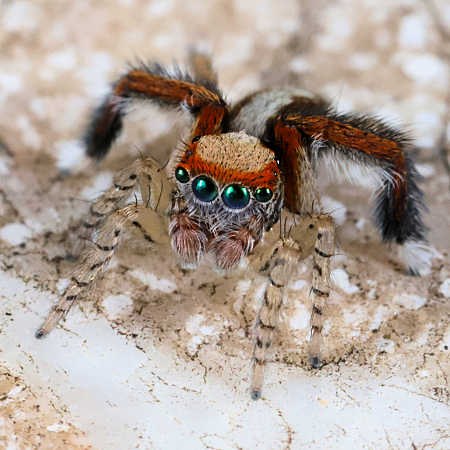
Only the Australian funnel back spiders are to be avoided, but with only two registered bites a year, not to worry about.
More about venomous spider bites in this review about the toxity of Tegenaria (hobo), Dysdera, Cheiracanthium (yellow-sac), Lampona, Missulena (mouse), Loxosceles (brown recluse), red-back (black widow), Atrax robustus (Sydney funnel web) and Hadrychone.


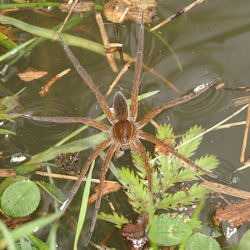
Young Dolomedes fimbriatus spider. As adult the largest European spider.


Which spiders can we find around the house? (Many more small spider pictures here ->)
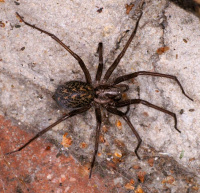
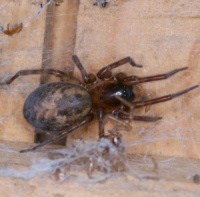
The house spider (Agelenidae) is a famous "scary" spider. In autumn the males are often spotted searching for a female. He runs on his long legs through our house,
especially if we are watching television. Leave him alone and after a few minutes he is gone or eaten by the cat.
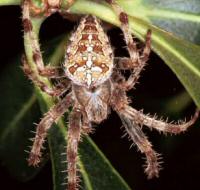
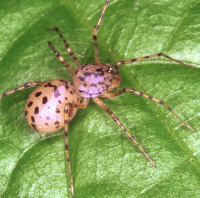
The garden spider (Araneidae) is also often seen in her wheel web. To see the glue spitter (Scytodidae) you have to look better.
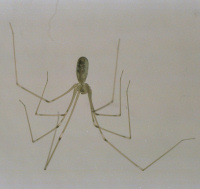
The daddy longleg (Pholcidae) is the greatest killer inside your house. In winter she almost kills all surviving insects and they even kill their own kin.

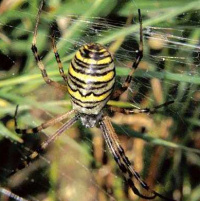
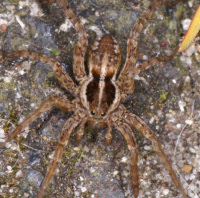
Vibrating spider Garden spider Wasp spider House spider Spitting spider
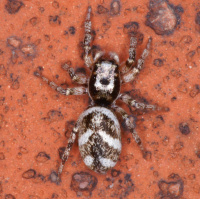
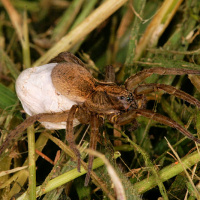
Meshweb weaver Zebra spider Wolf spider with egg cocoon Wolf spider Woodlouse spider
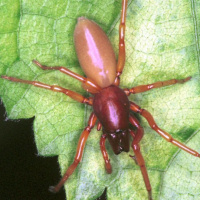
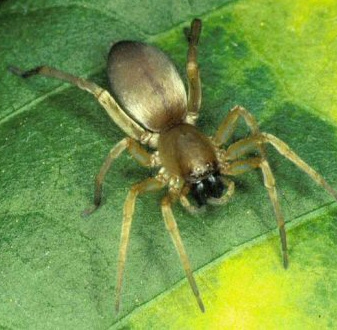
Sac spider Ground spider Sheet web spider Tent spider Crab spider
Tubeweb spider Meta spider Prowling spider Prowling spider Small huntsman spider
Lynx spider Stretch spider Stretch spider Nursery web spider Fishing spider
Sheetweb spider Lady bird spider Orb web spider Cob web spider Cob web spider

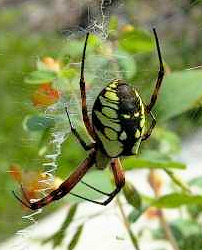
An impressive spider often seen in the US is the Argiope aurantia (Family Araneidae). Pictures of Argiopes from different continents can be seen on the following pages: Europe, USA and Australia.

In a study, the Panamese wheel spider was observed for a year. It consumed an average of 1.63 insects (= 0.089 g) a day. A study in Great Britain estimated an average of 130.8 spiders living in a meadow per square meter. If we extrapolate this to Holland with 15 million habitants on 36150 square kilometers (4.4 human beings per hectare), we can make the next calculation: spiders living on one hectare consume 116.4 kg of animal material every day. In other words, spiders eat the weight of all humans living in Holland in three days!

Argiope aurantia by Andrew Greif
  Argiope aurantia from the USA

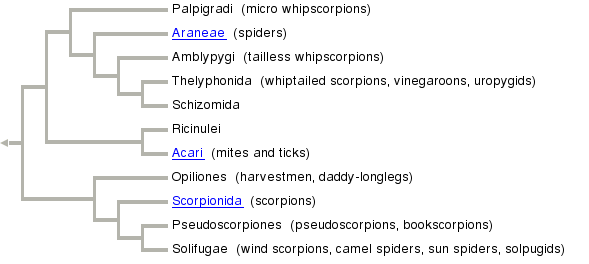
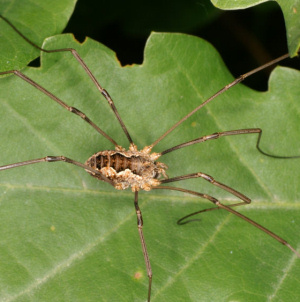
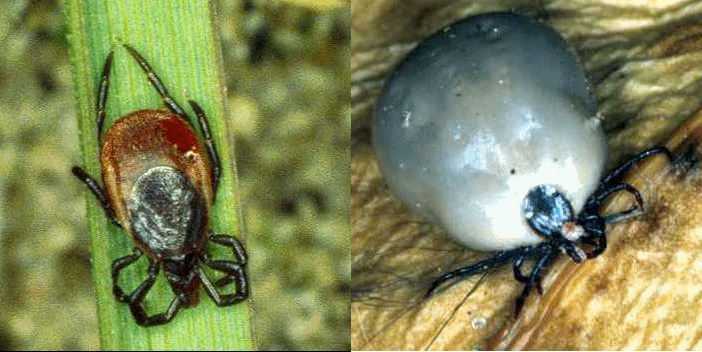
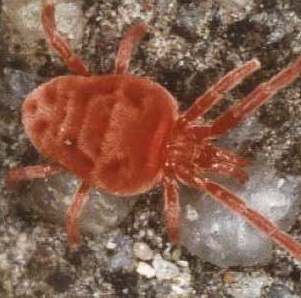
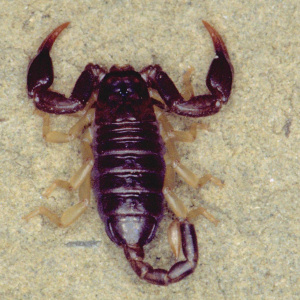
Many people confuse spiders with insects. Both belong to the phylum Arthropoda in the animal kingdom, which consists of animals with segmented bodies and jointed appendages. The phylum Arthropoda is divided into 5 classes. Animals with 4 pairs of legs such as spiders belong to the class called Arachnida and animals with 3 pairs of legs such as insects belong to the class called Insecta. Scorpions, pseudoscorpions, mites, harvestmen and ticks (which can cause Lyme disease), also have 4 pairs of legs, and therefore also belong to the Arachnida. Within the class Arachnida the spiders belong to the order called Araneae.
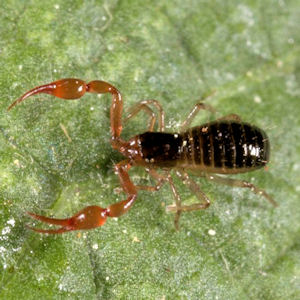
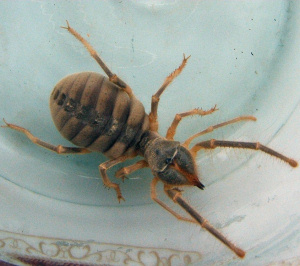
Arthropoda Class Arachnida
[down<--]Arthropoda [up-->]Araneae [up-->]Acari [up-->]Scorpionida Part of the tree of life site

Opiliones/Mitopus morio

Ixodes_ricinus

velvet mite

Opiliones, harvestmen, Mitopus morio

Acari, Tick, Ixodes ricinus before and after feeding

Acari, Velvet mite. Neotrombicula sp.

Euscorpius italicus

Neobisium sp.

Camel or sun spider

Scorpionida, Euscorpius italicus

Pseudoscorpiones, Neobisium sp.

Camel or sun spider, Solifugae by Oleg Kucheryavenko

Inter site links

Common spider information

Spider location chart, find your spider by behaviour
Pictures of common spiders
Australian spider site
Back to my start page
Thumbnail pictures for a quick overview
Glossary of terms
Perfect camping site in France
High resolution detail of the fangs of a spider
How thick is a thread to stop a Boeing-747 in full flight?
Spiders on La Gomera, Canary islands

Spider information
The demystification of the toxicity of spiders
Spinneninformatie (Dutch)
Pri araneoj en Esperanto
The anatomy of a spider
The spinnerets and the properties of silk
The construction of a wheel web
American Argiopes
List of spider families, genera and species from NW-Europe by name
All kind of mails
****Go back in time****


Pictures and information by family

Order Araneae - Spiders

 Sub-order - Orthognatha (Mygalomorphae, primitive spiders)

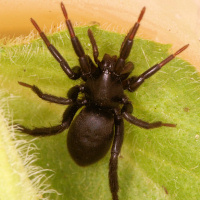
Atypidae, Purse-web spiders
 Sub-order Labidognatha (Aranaeomorphae, modern spiders)
Cribellatae (These spiders have a cribellum and a calamistrum)
Amaurobiidae, funnel weavers
Eresidae, lady bird spiders
Uloboridae, Cribellate orb spiders
Dictynidae, Small cribellate spiders
Oecobiidae, disc web spiders
Ecribellatae

Haplogynae (six eyed spiders)

Dysderidae, Cell spiders
Scytodidae, Spitting spiders
Oonopidae, Dwarfcel spiders
Segestriidae, Six-eyed spiders

 Entelegynae (eight eyed spiders)

Agelenidae, Funnel weavers, house spider
Cybaeidae Argyronetidae, Water spiders
Clubionidae, Sac spiders
Erigonidae, Dwarf spiders
Hahniidae, Dwarf funnel spiders
Liocranidae
Lycosidae, Wolf spiders
Mimetidae, Pirate spiders
Philodromidae, Crab spiders
Pisauridae, Big wolf or nursery web spiders
Tetragnathidae, Stretch spiders
Nesticidae, Cave cobweb spiders
Zoropsidae
Anyphaenidae, Sac spiders
Araneidae (Argiopidae), Orb web spiders
Cyrtophora (Araneidae), Tent web spider
Gnaphosidae, Ground spiders
Heteropodidae, Hunt crab spiders
Linyphiidae, Sheetweb spiders
Metidae, Orb stretch spiders
Miturgidae, Prowling spiders
Oxyopidae, Lynx spiders
Pholcidae, Daddy longleg spiders
Salticidae, Jumping spiders
Theridiidae, Nesticidae,Cob web spiders
Thomisidae, Crab spiders
Zoridae (Ctenidae), Wandering spiders

Order Opiliones - Harvestmen

Trodulidae & Nemastomatidae & Phalangiidae 


More informational links (<-- click link)

European spiders
The Arachnology home page
Belgische Arachnologische Vereniging
Central European Spiders
Jørgen Lissner Spiders of Europe
Spiders of Britain & Europe, Nick Loven

Groupe d'etude des Arachnides, Lionel Dabat
Aranea Norvegiae
Arachnids, arthropods, reptiles of Europe
Arachnodata
Arachnoligische gesellschaft e.V.
Hoehlenspinnen
Aracnis, European spiders & their kin
Belgian spider site from Gie Wyckmans
Opiliones in Belgium from Luc Vanhercke
French jumping spiders from Yvan Montardi
British Arachnological Society
The Families of Spiders Represented in the British Isles
Russian spiders
European Society of Arachnology

American spiders
Spiders on the web by Peter Bryant
American Arachnological Society

Australian spiders
Australasian Arachnological Society
The Australian spider page from Glenda Crew
Steve's Australian spider pics
Brisbane Spiders by Peter Chew
The Find-a-spider Guide
Tasmanian spiders

Special sites
Salticidae of the world by Jerzy Proszynski
The world spider catalog, Platnick
Camel spiders or Solifugids
Tree of life
Venomous spiders  
Arachnophilia, The wonderful world of spiders
The spider myth site
Spider control
Spider links
Spinnen in terraria Belgium
Insects and spiders in Japan
German nature site www.natur-in-nrw.de
Pholcidae - The longest legs in the web

Equipment for Entomology and Related Sciences

An overview review of the toxity of the spiders

Brown recluse, fiddleback spider
Brown Recluse Spider, pictures, info and links
Brown recluse spider.com
Brown recluse, univ of California

Brown Recluse Spider, Ohio state univ
Recluse spiders, Hobo spider web site
Hobo spider
Hobospider.com
Hobo spider web site

Black Widow, Red back, Malmigatte
Red back, Queensland museum
Red back, Australian museum
Black widow spiders, Desert USA
Black Widow Spider, Univ of Michigan
Latrodectus species (German)
In Europe
In Australia
the SPIDER webring
[ Join Now | Ring Hub | Random | << Prev | Next >> ]

Literature

  1. W. van Katwijk, Spinnen van Nederland, 1976, Balkema - Rotterdam - The Netherlands, ISBN 90 6191 1028
  2. B. Goethals, Een spin als huisgenoot, Tirion Natuur, The Netherlands, ISBN 9052105073
  3. H. Vanuytven, Leven op acht poten, Panaman, Belgium, ISBN 9080961116
  4. D. Jones, Spinnen, 1983, Thieme - Baarn - The Netherlands, ISBN 90 5210 121 3
  5. H. Pfletsinger, Spinnen, Thieme - Zutphen - The Netherlands, ISBN 9009 95020 2
  6. F. Sauer, J. Wunderlich, Die schönsten Spinnen Europas, 1991, Eichenweg 8, 8047 Karlsfeld, Germany, ISBN 3 923010 03 6
  7. B. & M. Baehr, Welche Spinne ist das?, 1987, Kosmos naturführer, Stuttgart, Germany, ISBN 3 440 05798 4
  8. H. Bellman, Spinnen beobachten, bestimmen, 1992, Naturbuch verlag, Augsburg, Germany, ISBN 3 89440 064 1
  9. E. Kullmann, H. Stern, Leben am seidenen Faden, Die rätselvolle welt der spinnen, 1975, Verlagsgruppe Bertelsmann Verlag, Munchen, Germany, ISBN 90 222 0239 9
  10. M.J. Roberts, Spiders of Britain & northern Europe, 1995, Harper Collins Publishers, ISBN 000 219981 5
  11. R & K Preston-Mafham, Spiders of the world, 1984, Blandford, ISBN0 7137 2392 0
  12. Journals published by the Werkgroep Inheemse Spinnen (WIS), Bollenbergen 45, 9052 Zwijnaarde, Belgium
  13. H. Bellmann, Spinnentiere Europas, 1997, Kosmos, Stuttgart, Germany, ISBN 3-440-07025-5
  14. B. Simon - Brunett, The silken web, 1994, Reed books, Chatswood NSW, Australia, ISBN 0 7301 0401 X
  15. S. Heimer, Spinnen, 1997, Landbuch verlag, Hannover, Germany, ISBN 3 7842 0543 7
  16. W.J. Gertsch, American spiders, 1949, D. van Nostrand company, USA
  17. R. Mascord, Australian spiders, 1970, Reed, Artarmon, Australia, SBN 589 07065 7
  18. K.C. McKeown, Australian spiders, 1962, Sirius books, Australia
  19. R.F. Foelix, Biology of spiders, 1996, Oxford university press, ISBN 0-19-509594-4
  20. P. Hillyard, The book of the spider, 1994,Avon books,ISBN 9 780380 730759
  21. J.H. Emerton, The common spiders of the United States, 1961, Dover publications, New York, ISBN 9 780486 202235
  22. T.H. Savory, The spiders & allied orders of the British isles, 1935, Frederick Wayne & Co, London
  23. E. Simon, Les arachnides de France Tome 6 , 1914 - 1937, Paris.
  24. E. Simon, Histoire naturelle de araignees, 1864, Paris
  25. R. Jocqué, AS Dippenaar-Schoeman, Spider families of the world, 2006 royal museum for central Africa, ISBN 90-75894-85-6


Because of their big variety in color, shape and size, it is difficult to determine a spider from a picture. The only secure way is to catch the spider and have proper books on identification.
I have tried to give them the right name. If you can correct, E-mail me. E-mail: Click here


Ed Nieuwenhuys, 12 july 2009

Copyright 1 february 1996-2009