Trelawny served in the navy, but he left it when he was nineteen
years old. He returned to England where he married Julia Addison
in 1813. She ran away with a captain Coleman and a divorce followed
in 1819. He received an allowance of 300 pounds a year and he
decided to leave England and live in a cheaper country.
He
went to taly, where he falsely claimed to have led the life
of a corsair. He met Lord Byron and he knew Shelley in his last
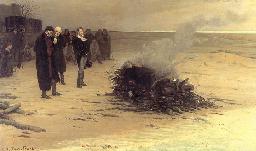
days in 1822. Trelawny conducted the cremation of Shelley after
his death and took care of his ashes. Together with Byron he
travelled to Greece in 1823, to help them with their struggle
for independence against the Turks. Byron died in 1824 and Trelawny
joined the clan of the greek chief Odysseus, that lived in a
cave in the mountains. He returned to England after the clan
fell apart and an attempt on his life was made by William Whitcombe
on 11 Jun 1825. In Greece he had married a local woman, Tarsitsa
Kamenou, but he divorced her in 1827. They had a surviving daughter,
Zella (c1826-1907).
Trelawny always remained a radical
trying to impress people and he assumed the role of protector
of the values and the work of his 'great friend' Shelley. Trelawny
even accused Mary Shelley of betraying Shelley's ideals by living
too conventiously, completely neglecting her position as a widow
with a son to raise. In 1833 he travelled to the US and tried
to swim across the Niagara Falls, almost drowning during the
attempt. He returned to England in 1835 and was politically
active with the group the Philosophical Radicals.
He
had started an affair with Augusta Goring (born Harvey) and
in 1839 he withdrew from London society and settled in a villa
on Putney Hill owned by his political friend John Temple Leader.
In that year Augusta gave birth to a son. Her husband divorced
her in 1841 and they married. They bought a farmhouse in Usk
in Wales and their daughter Laetitia was born in 1848. The marriage
ended in 1857 after he 'took up with a Miss B'. It was never
discovered who she was.
Around 1870 he settled in a
cottage at West Street in Sompting near Worthing, Sussex. Trelawny
had already met the painter Millais at the funeral of the cartoonist
John Leech at Kensal Green Cemetery in 1864, but when Millais
asked him in 1874 to sit for a portrait he wouldn't know of
it. Millais' wife Effie finally persuaded him and the grand
old man became the model for the old sailor on "The North-West
Passage" (1874, The Tate Gallery, London). Trelawny, who was
eighty-two by now, hated the result and even threatened a duel
to Millais.
Towards the end of his life life he
lived with a woman named emma Taylor. He told others that she
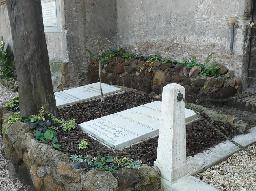
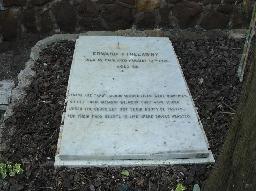
was his niece. Back in 1822 Trelawny had purchased the plot
next to Shelley at the Protestant Cemetery in Rome. After his
death in 1881 his remains were cremated and Emma brought them
to Rome where they were buried.
Trelawny's book "Records
of Byron, Shelley and The Author" (1878) proved fascinating
reading for those interested in Byron, Shelley or the author
himself, but in later years scholars proved many of his claims
to be false. Slowly it turned out that many of the stories he
been telling for over half a century in such a convincing way
were mostly made up by himself. He had never even met his 'friend'
Keats for example and the famous corsair The Ruiter didn't exist.
Family
• Daughter: Trelawny, Zella
• Wife: Goring, Augusta (1846-1857, Gloucestershire) (divorce or separation)
Related persons
• was a friend of Byron, George Noel Gordon
• was a friend of Clairmont, Claire
• has a connection with D'Arcy Bacon, Francis
• knew Haydon, Benjamin
• visited Kemble, Adelaide
• was a friend of Kemble, Fanny
• was a friend of Medwin, Thomas
• knew Medwin, Thomas
• was painted by Millais, John
• was a friend of Norton, Caroline
• was a friend of Rossetti, William Michael
• knew Severn, Joseph
• has a connection with Shelley, Mary
• was a friend of Shelley, Percy Bysshe
• was attacked by Whitcombe, William
• knew Williams, Edward Ellerker
• knew Williams, Jane
|
Events
| | |